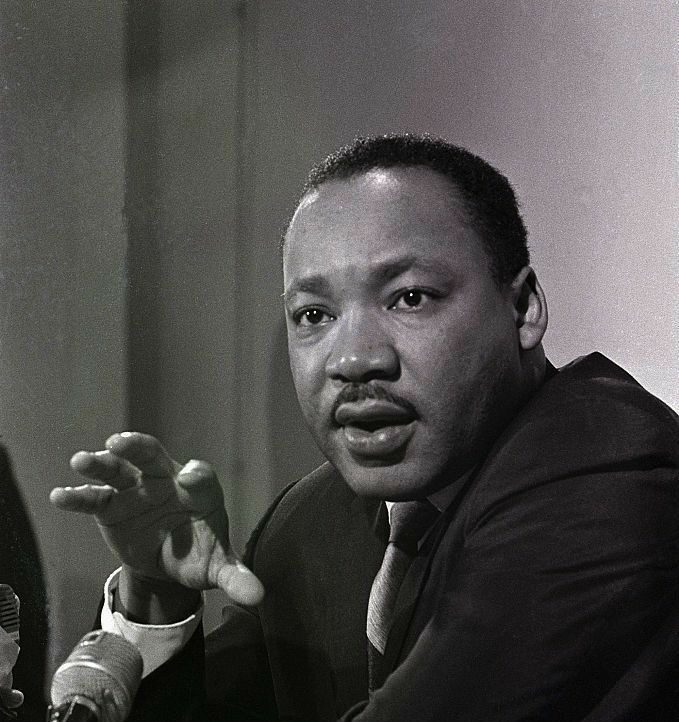
MLK Day is always described as “a day on, not a day off.” Every MLK Day invites us to reflect on what service truly looks like. Service is an act of love, not just symbolic love, but practical, everyday care for the people who share our city, our struggles, and our hope for something better. Dr. King believed that justice had to reach every corner of people’s lives. His vision was never abstract; it was rooted in lived experiences, from dignity and opportunity to health and nourishment. To honor that legacy means we show up in ways that strengthen our communities and protect our collective well-being.
This year, I chose to honor this day of service by serving with West Atlanta Watershed Alliance (WAWA) through Breaking the Cycle Global. Our group spent the time pulling an invasive ivy species out of the ground, work that was physical, collective, and symbolic all at once. Environmental health and community health are deeply connected, and the health of a community begins with the spaces that sustain it. Restoration work isn’t just about plants or soil; it’s about access, safety, nourishment, and the ability for communities to thrive. It’s shaped by systems, resources, and history, which makes it clear that health is political. And in that same way, food justice becomes racial justice because the ability to eat well and live well has never been distributed equally.
Honoring Dr. King means recognizing that justice must extend beyond words and into the conditions that allow communities to flourish. Restoring and showcasing care for shared spaces is one way to live out that vision, his dream, by protecting the foundations of health and continuing the work of building the collaborative community he imagined.
Food Justice is Racial Justice
Doing restoration work made me reflect on how many of our community challenges are rooted in systems much larger than us. Health is shaped by personal choices, policy, access, and the environments in which we live, learn, and eat. Our ability to access green space, clean water, or affordable produce isn’t random; it’s a direct result of decades of planning, investment, and neglect.
Health is political, and this is why food justice is interconnected with racial justice.
In predominantly Black neighborhoods, nutritious foods are often limited, overpriced, or entirely unavailable. Families are often pushed towards fast food chains and ultra-processed foods because of accessibility. These areas are referred to as food deserts or food apartheid zones. This is not an overnight trend; it is a product of zoning laws that exclude supermarkets from certain neighborhoods, a history of redlining that shapes where opportunity lives, and economic disinvestment that drives out fresh food retailers. When a community has more liquor stores and fast-food chains than fresh produce grocery stores, it shapes the everyday decisions people can make about their health.
Beyond that, many Black individuals lack access to nutritional and health education, thus creating gaps in knowledge that mirror the same gaps in resources. Information about balanced eating, disease prevention, and wellness is treated as a privilege rather than a public necessity. It is found through private healthcare, well-funded schools, or spaces that are financially inaccessible to many communities. When we are never taught how food impacts our bodies or are only exposed to messages rooted in blame or restriction, health disparities are reinforced rather than resolved.
Dr. King fought not just for civil rights, but for economic and social conditions that allowed Black families to thrive. To expand this work, we have to confront the inequities in our food systems and fight for environments where health isn’t determined by ZIP code.
How I’m Carrying This Forward
Service can’t begin and end with a single moment; it is a long-term commitment, peeling back layers of inequity and choosing to stay engaged when the day of service is over.
For me, carrying this forward looks like continuously showing up by deepening my learning about food systems and public health, so I can advocate with intention. It means supporting organizations that are repairing and restoring our neighborhoods, not just on MLK Day, but consistently throughout the year. It means working towards a future where wellness is not reserved for the few but accessible for all.
Most importantly, it means leading with love. Dr. King believed that love was a powerful force for social transformation, capable of restoring dignity and building community. By choosing service over silence, I am honoring that belief.
Honoring Dr. King means uplifting the legacy that was never meant to live only in speeches or history books, but through our actions, decisions, and how we use our voices. The willingness to act long after the day is over is a catalyst for the change we wish to see. As Dr. King said, “Our lives begin to end the day we become silent about things that matter.” Silence benefits the very systems that create inequity. Whether it’s restoring land, challenging political systems, or advocating for food justice, the work we do today shapes the future Dr. King fought for. Through service, learning, and HerBalancedTable, I carry this reminder with me: greatness is in our ability to serve, uplift, and build a future rooted in intentional collaboration. True impact is sustained when each generation builds upon the foundation laid by those who came before them.
“Everybody can be great…because anybody can serve. You don’t have to have a college degree to serve. You don’t have to make your subject and verb agree to serve. You only need a heart full of grace. A soul generated by love.”
― Martin Luther King Jr


